
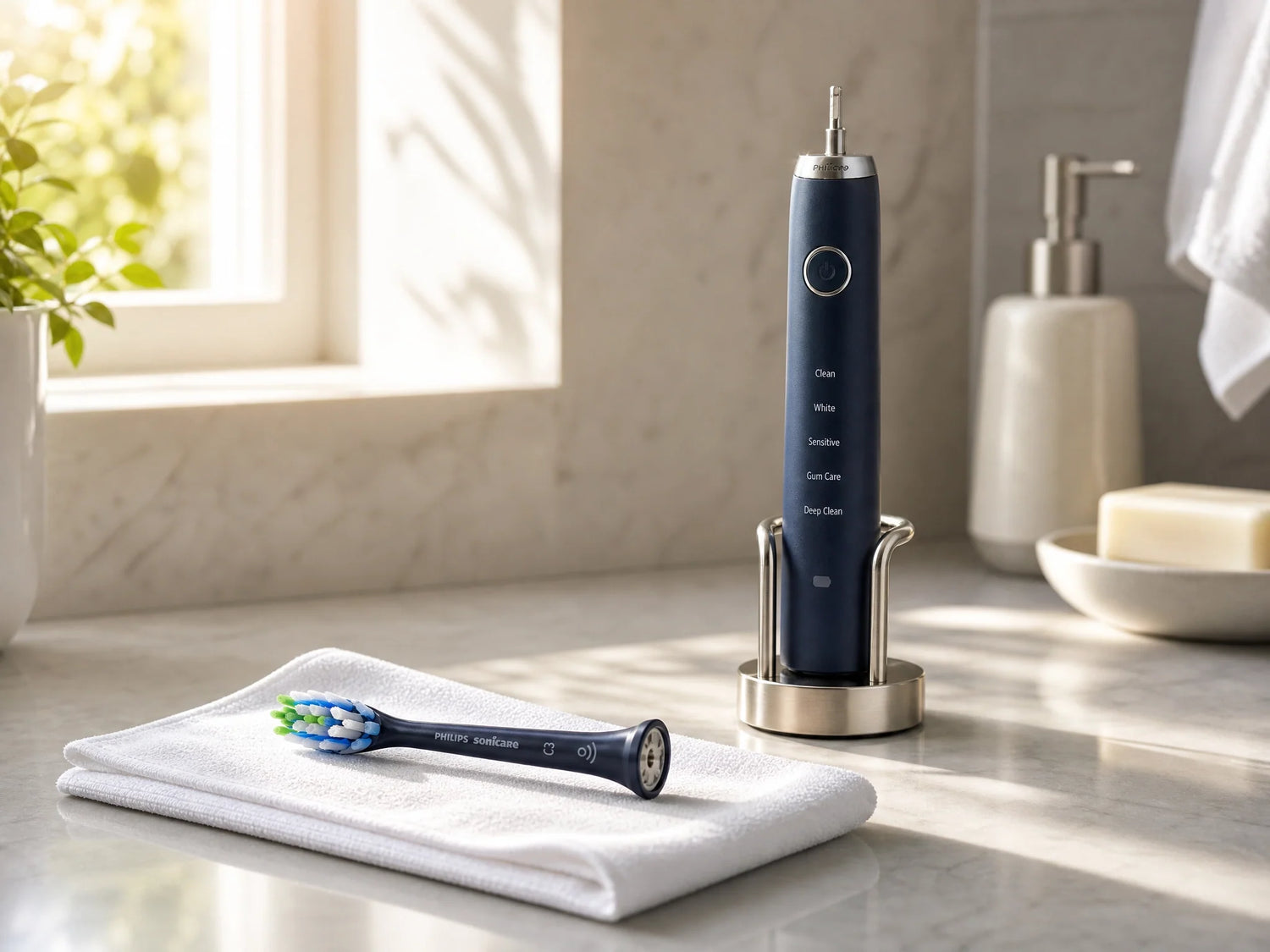
Une brosse à dents rangée verticalement, loin des toilettes, et laissée sécher complètement entre les utilisations est l'une des défenses les plus simples contre les bactéries et les moisissures. Cela permet également à votre tête de brosse de fonctionner efficacement pendant les 3 mois complets.
Votre brosse à dents électrique nettoie vos dents, mais la façon dont vous la rangez détermine à quel point la brosse elle-même reste propre. Même la brosse la plus avancée peut devenir un foyer pour les moisissures, les bactéries et les résidus de dentifrice si elle reste dans un endroit humide et clos. La bonne nouvelle : quelques petites habitudes constantes font toute la différence.
Pourquoi le rangement adéquat de la brosse à dents électrique est plus important que vous ne le pensez
Une brosse à dents humide laissée dans un tiroir fermé ou recouverte d'un capuchon protecteur immédiatement après utilisation crée la tempête parfaite pour la croissance microbienne. Les moisissures prospèrent dans les environnements chauds et humides avec peu de circulation d'air, et les salles de bain fournissent souvent exactement ces conditions. Une fois que la moisissure s'installe sur une tête de brosse ou autour du point de connexion métallique, elle peut réintroduire des germes dans votre bouche à chaque utilisation — et même contribuer à des infections buccales ou à des irritations respiratoires. Pour les personnes ayant des gencives sensibles ou qui saignent, ce risque est encore plus préoccupant, car les bactéries peuvent rapidement aggraver les problèmes de gencives existants.
C'est pourquoi choisir une brosse à dents qui minimise les endroits où les bactéries peuvent se cacher tout en nettoyant en douceur — comme la RANVOO AirJet X5 avec sa technologie innovante de brosse à bulles — peut faire une différence significative pour ceux qui se soucient de la santé des gencives. Selon l'American Dental Association, un rangement correct de la brosse à dents prévient activement la contamination croisée, prolonge la durée de vie de la tête de brosse et réduit les risques de maladie des gencives. BrushO explique que des millions de bactéries entrent en contact avec votre brosse quotidiennement, donc le rangement n'est pas seulement une question de propreté — c'est une étape d'hygiène aussi importante que le brossage lui-même.
Que se passe-t-il lorsque vous rangez votre brosse à dents électrique de manière incorrecte ?
Lorsque le rangement est incorrect, les conséquences sont à la fois visibles et invisibles. Voici ce qui peut arriver :
- Les moisissures et le mildiou apparaissent sous forme de taches noires ou roses sur la tête de brosse, le manche ou à l'intérieur du point de connexion — surtout là où l'humidité s'accumule après utilisation.
- Les dommages aux poils se produisent lorsqu'une tête humide est coincée contre d'autres brosses ou aplatie contre une surface, ce qui fait que les poils s'effilochent et perdent leur pouvoir nettoyant.
- Le transfert de bactéries se produit lorsque les têtes de brosse à dents se touchent dans un support partagé, permettant aux germes de passer d'une brosse à l'autre.
- La contrainte du moteur peut se développer si des résidus de dentifrice collants durcissent autour de l'arbre métallique, forçant le mécanisme d'entraînement à travailler plus fort et raccourcissant la durée de vie du manche.
- Les odeurs désagréables signalent que des bactéries et des moisissures se développent dans les endroits profonds et difficiles d'accès de la tête de brosse ou du manche.

Où ranger une brosse à dents électrique : trouver l'endroit idéal
Le bon emplacement équilibre trois choses : la ventilation, distance de la contamination, et protection contre les particules en suspension dans l'air. Les endroits ouverts et aérés surpassent toujours les espaces clos. Gardez la brosse à au moins 1,8 mètre des toilettes et du lavabo pour éviter tout contact direct avec les éclaboussures et les aérosols. Si possible, placez-la de manière à ce qu'elle ne soit pas dans un coin où l'humidité persiste après une douche.
| Zone de stockage | Ventilation | Exposition aux éclaboussures | Note globale d'hygiène |
|---|---|---|---|
| Comptoir ouvert (éloigné des toilettes) | Excellente | Modérée | Idéal pour un usage quotidien |
| Support mural | Excellente | Faible | Idéal pour les petites salles de bains |
| Armoire à pharmacie (à l'intérieur) | Mauvaise | Aucune | Risqué à moins que l'armoire reste ouverte pour sécher |
| Tiroir fermé | Très mauvaise | Aucune | À éviter — emprisonne l'humidité et les bactéries |
Les dangers du panache de la cuvette
Chaque chasse d'eau sans abaisser le couvercle envoie un spray invisible de gouttelettes microscopiques dans l'air — parfois jusqu'à 1,8 mètre. Ces gouttelettes peuvent transporter des bactéries et atteindre votre brosse à dents. Une règle simple résout ce problème : fermez le couvercle des toilettes avant de tirer la chasse. C'est le moyen le plus efficace de garder les germes en aérosol loin de votre brosse.
Comptoir de salle de bains vs. armoire vs. support mural : avantages et inconvénients
- Comptoir ouvert (verre ou support vertical) : Offre les meilleures conditions de séchage à l'air, mais doit être placé loin des zones d'éclaboussures. Un support dédié et ventilé qui sépare les brosses est idéal.
- Armoire à pharmacie : Protège des projections de la cuvette et des éclaboussures de surface, mais réduit considérablement la circulation de l'air, sauf si on la laisse ouverte après utilisation. Si vous utilisez une armoire, attendez que la brosse soit complètement sèche avant de fermer la porte.
- Support mural : Gagne de l'espace, éloigne la brosse des flaques sur le comptoir et permet une circulation d'air à 360°. Idéal si associé à un support adhésif placé à hauteur des yeux, loin des toilettes.
Comment ranger une brosse à dents électrique immédiatement après le brossage (étape par étape)
Suivez cette séquence à chaque brossage :
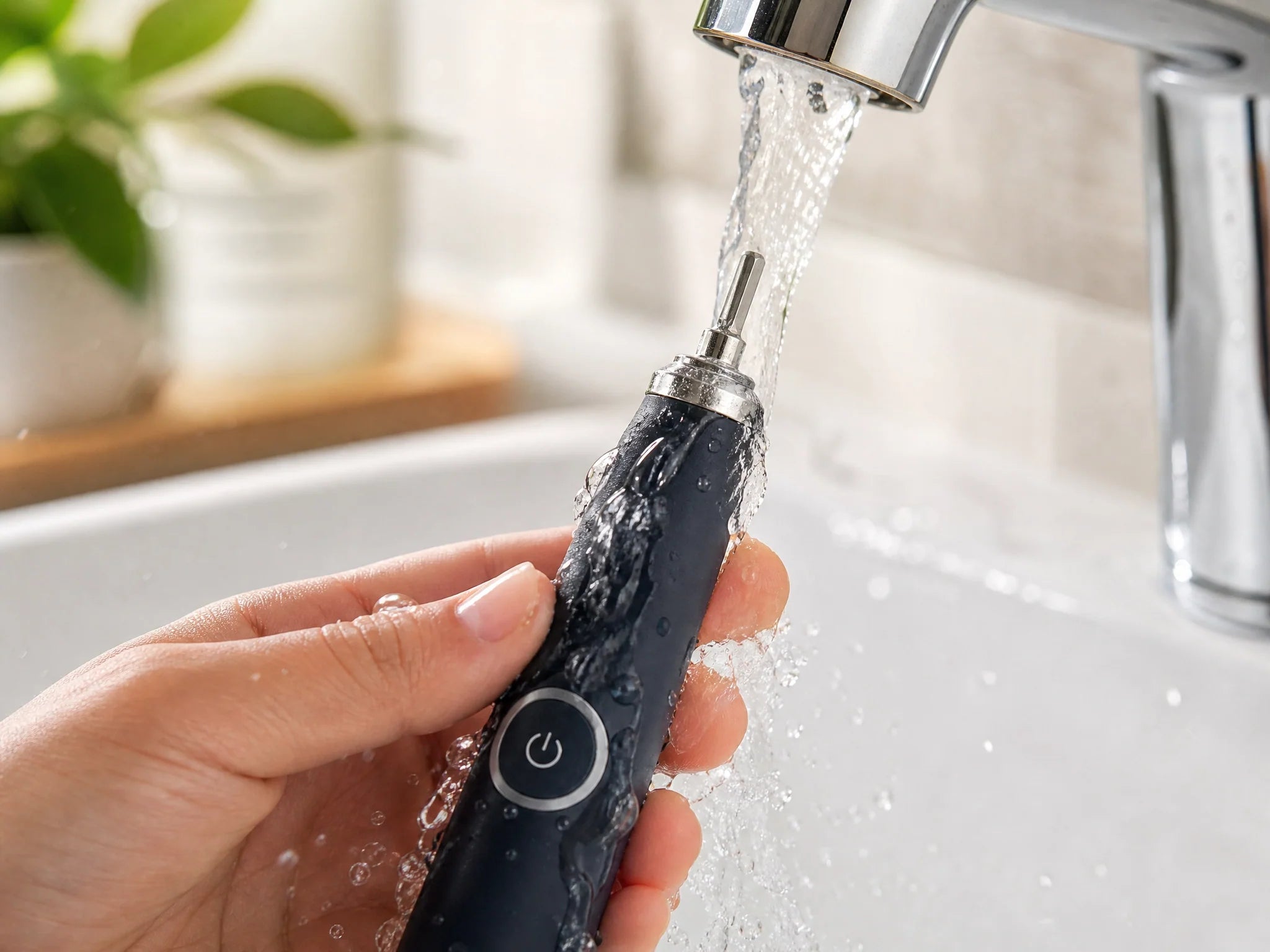
- Rincez soigneusement la tête de brosse sous l'eau courante, en orientant les poils vers le bas afin que l'eau s'écoule loin du manche.
- Secouez l'excès d'eau avec quelques secousses fermes — cela élimine l'humidité piégée au fond des poils.
- Essuyez le manche et la tige métallique avec un chiffon sec et propre ou un mouchoir en papier pour retirer tout résidu de dentifrice.
- Détachez la tête de brosse du manche au moins une fois par jour (idéalement après la dernière utilisation de la journée) pour laisser sécher les deux pièces séparément à l'air libre.
- Placez le manche à la verticale dans un support qui permet la circulation de l'air, et la tête de brosse sur une surface propre et sèche ou dans son logement vertical séparé.
- Laissez-la découverte, à l'air libre, jusqu'à ce qu'elle soit complètement sèche au toucher.
Rinçage et élimination de l'excès d'eau
Tenez la tête de brosse sous l'eau du robinet et frottez doucement les poils avec vos doigts pour décoller tout résidu de dentifrice. Ensuite, tout en l'éloignant de votre visage, donnez-lui deux ou trois secousses vives vers le bas. L'objectif est de ne voir aucune gouttelette visible s'accumuler à la base des poils. Pour une protection supplémentaire, pensez à faire couler de l'eau sur la zone de la tige métallique pendant que la tête est retirée afin d'éliminer toute saleté qui a commencé à se former. La documentation officielle de Philips recommande de retirer la tête de brosse et de rincer la tige métallique à l'eau tiède après chaque utilisation.
Séchage du manche et de la tête de brosse séparément
Lorsque vous laissez la tête de brosse attachée à un manche humide, l'humidité et les minuscules particules alimentaires s'accumulent au point de connexion — là où le plastique rencontre le métal. Cette zone cachée est l'un des endroits les plus courants où la moisissure commence à se former. Retirer la tête et essuyer à la fois la tige et l'intérieur de la tête avec un chiffon propre et sec ne prend que quelques secondes, mais empêche des jours d'accumulation bactérienne. Même un essuie-tout fonctionne ; assurez-vous simplement de ne pas laisser de peluches.

Quand utiliser un étui ou une housse pour brosse à dents (et quand les éviter)
Il y a une grande différence entre le rangement quotidien à la maison et la protection en voyage. À la maison, ne mettez jamais un capuchon de protection fermé ou un étui hermétique juste après le brossage. Cela emprisonne l'humidité et crée une chambre hermétique et humide où les bactéries se multiplient rapidement. Un étui humide fait plus de mal que de bien.
Avertissement : L'utilisation quotidienne d'un capuchon hermétique est l'un des moyens les plus rapides de faire pousser de la moisissure sur une tête de brosse. Gardez-la ventilée, toujours.
Rangement en voyage : comment ranger votre brosse à dents électrique en toute sécurité
Le voyage est le moment où un étui devient essentiel, mais il faut le bon type. Suivez ces conseils :
- Ne rangez la brosse à dents que lorsque la tête de brosse et le manche sont complètement secs. Si vous êtes pressé, essuyez les deux soigneusement avec une serviette.
- Utilisez un étui de voyage ventilé qui a des trous d'aération ou des côtés en tissu respirant. Une boîte en plastique solide emprisonne toute humidité résiduelle.
- Si votre brosse a une batterie, rangez-la dans un endroit frais et sec — pas dans une voiture chaude ou en plein soleil — pour protéger la batterie lithium-ion.
- À l'arrivée, déballez et aérez la brosse immédiatement, et essuyez rapidement le manche.
- Lavez l'étui de voyage lui-même régulièrement ; rincez-le à l'eau et laissez-le sécher à l'envers pour éviter qu'il ne devienne un réservoir de bactéries.
Meilleurs accessoires de rangement pour une brosse à dents électrique
Améliorer votre configuration de rangement ne nécessite rien de sophistiqué. Voici quelques aides utiles :
- Support de brosse à dents ventilé : Recherchez un design à coupelle ouverte ou un support avec des fentes dédiées qui empêchent les brosses de se toucher et laissent l'air circuler autour de chaque tête.
- Support mural adhésif : Libère de l'espace sur le comptoir et éloigne la brosse de l'eau stagnante. Beaucoup permettent au manche de pendre à la verticale, ce qui facilite le séchage.
- Stérilisateur UV : Un appareil qui utilise la lumière UV-C pour réduire les bactéries de surface sur la tête de brosse. Ce n'est pas un remplacement du rinçage, mais un boost d'hygiène potentiel pour ceux qui veulent une tranquillité d'esprit supplémentaire.
- Sachets dessicants : Un petit sachet de gel de silice placé près du support peut aider à absorber l'humidité de la salle de bain, particulièrement utile dans les salles de bain exiguës et sans fenêtre.
Les stérilisateurs UV fonctionnent-ils vraiment ?
La lumière UV-C tue efficacement de nombreuses bactéries et virus sur les surfaces, mais ce n'est pas une solution magique. Oral-B note qu'il n'y a aucune preuve solide que les stérilisateurs gardent les brosses à dents significativement plus propres qu'un simple rinçage et séchage à l'air seul. Ce que la lumière UV peut faire : réduire le nombre de microbes sur des poils déjà propres. Ce qu'elle ne peut pas faire : enlever les résidus de dentifrice, l'accumulation de dentifrice au fond de la tête, ou la moisissure déjà incrustée dans les pores du plastique. Considérez un sanitiseur UV comme un ajout facultatif, et non comme un substitut à un séchage adéquat et au remplacement régulier de la tête.
Comment entretenir votre brosse à dents électrique avec des habitudes de rangement intelligentes
Le rangement n'est pas un choix ponctuel — c'est une pratique quotidienne qui préserve le moteur, la batterie et l'hygiène de votre brosse. Combinez ces habitudes :
- Remplacez la tête de brosse tous les 3 mois (ou plus tôt si les poils sont effilochés). Une tête usée perd en efficacité et abrite davantage de bactéries.
- Une fois par semaine, essuyez toute la poignée et la base de charge avec un chiffon propre et humide. Les éclaboussures de dentifrice et la poussière s'accumulent dans les interstices et sur la surface du chargeur.
- Nettoyez la connexion de la tige métallique avec un chiffon sec et doux tous les quelques jours et rincez à l'eau chaque semaine pour éliminer les résidus cachés. N'utilisez jamais d'objets pointus près du joint en caoutchouc.
- Si vous n'utilisez pas la brosse à dents pendant une longue période, rangez-la avec une charge partielle (environ 50 %) dans un endroit frais et sec, à l'abri du soleil. Retirez d'abord la tête de brosse.
Erreurs courantes à éviter lors du rangement d'une brosse à dents électrique
- Ne posez pas la brosse à plat sur le comptoir. L'humidité s'accumule et les poils peuvent se déformer.
- Ne partagez pas un porte-brosse à dents sans séparateurs. La contamination croisée entre les membres de la famille est réelle ; gardez les poils séparés.
- Ne la rangez pas dans un tiroir. Même si cela semble propre, l'obscurité et le manque de circulation d'air invitent à la moisissure.
- N'oubliez pas de sécher la zone du chargeur. Une base humide peut corroder les contacts et créer des risques électriques avec le temps.
- Ne laissez pas la brosse sur le chargeur 24h/24 si vous pouvez l'éviter. Des cycles de décharge complets occasionnels aident à maintenir la santé de la batterie au fil des ans.
- Ne rangez pas une brosse humide dans un étui de voyage scellé. La moisissure se formera avant même votre arrivée.
Liste de contrôle finale de la routine de rangement pour une brosse à dents fraîche et durable
Voici un rythme simple à suivre :
Quotidien - Rincez la tête de brosse et le manche après chaque utilisation - Secouez l'excès d'eau et laissez sécher en position verticale, à l'air libre - Séparez la tête et le manche pour le séchage au moins une fois (idéalement pendant la nuit)
Hebdomadaire - Essuyez le manche, la base de chargement et le support avec un chiffon humide - Rincez la zone de connexion entre la tête et le manche à l'eau tiède - Lavez l'étui de voyage à l'eau si vous l'avez utilisé cette semaine
Mensuel - Nettoyez en profondeur le support (trempez-le dans de l'eau savonneuse douce) - Inspectez les poils de la tête de brosse pour détecter tout signe d'effilochage — remplacez-la si nécessaire - Si vous utilisez un désinfectant UV, essuyez son intérieur avec un chiffon sec
Tous les 3 mois - Remplacez la tête de brosse par une nouvelle tête authentique - Vérifiez que la base de chargement ne présente pas de corrosion ou d'accumulation, et nettoyez-la soigneusement
Ranger votre brosse à dents électrique correctement ne demande presque pas de temps supplémentaire, mais cela protège votre santé, prolonge la durée de vie de votre appareil et préserve cette sensation de fraîcheur propre. En résumé : Laissez-la respirer, gardez-la au sec et gardez-la séparée.




Laisser un commentaire
Ce site est protégé par hCaptcha, et la Politique de confidentialité et les Conditions de service de hCaptcha s’appliquent.