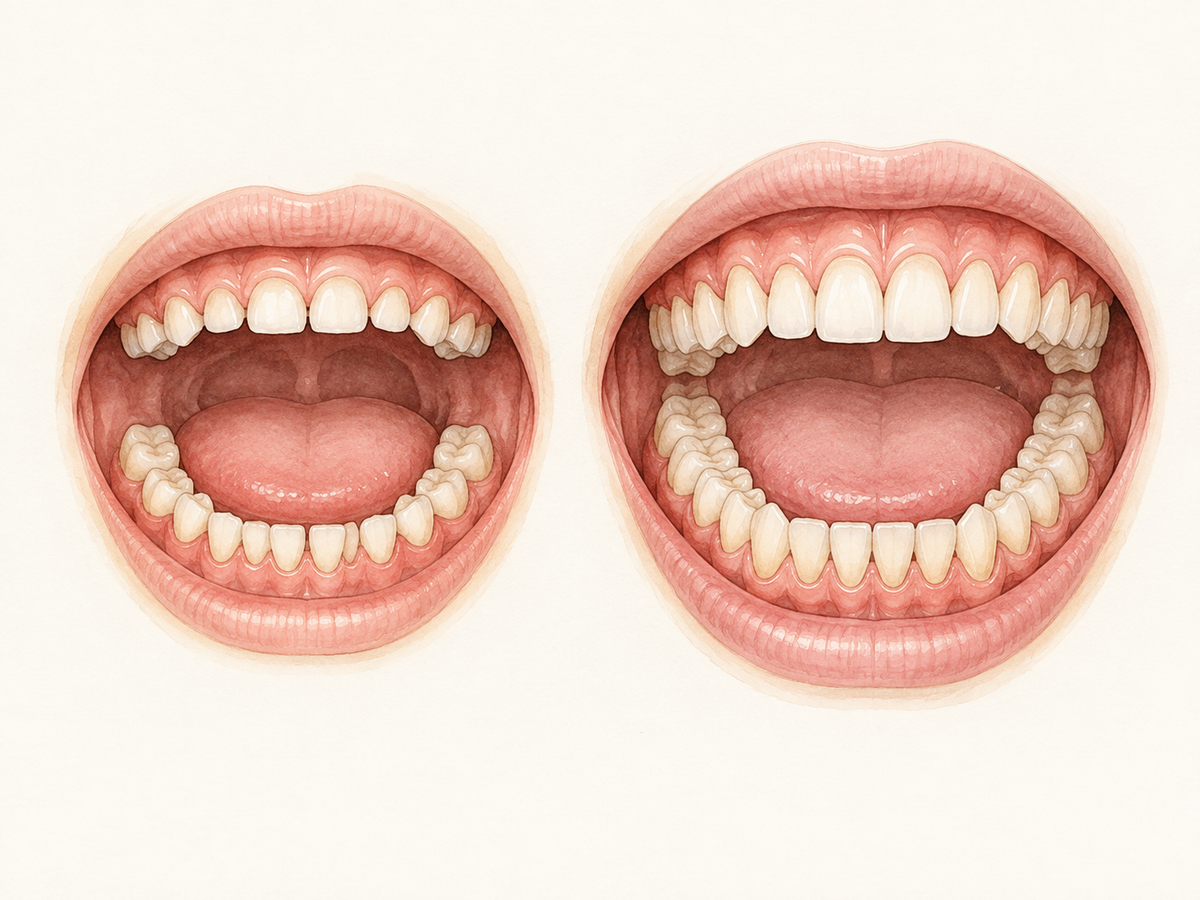
Most adults have 32 permanent teeth, and children start with 20 baby teeth. A full adult set is 32, but many adults have 28 because wisdom teeth are removed or never come in. That 28-tooth set is still a normal working set.
The main thing to know: 20 baby teeth, 32 adult teeth. Without wisdom teeth, 28 is common and still functional.
How Many Baby Teeth? (The First 20)
A child’s first set is 20 baby teeth, also called primary teeth. The lower front teeth usually come through first, and the full set is typically in place by about age 3.
The schedule is not exact. In one Turkish study, the first tooth appeared at a median of 6.9 months and the last baby tooth at about 26.8 months. In an Australian study, those numbers were 8.6 and 27.9 months. So a few months earlier or later is often normal.
Children have 20 teeth because their jaws are still small and growing. Baby teeth hold space for the bigger adult teeth that come later.
How Many Adult Teeth? (The Full Set of 32)
By the late teens, most people have 32 permanent teeth: 16 in the upper jaw and 16 in the lower jaw, according to standard dental anatomy. The last teeth, wisdom teeth, may appear around age 18 or later.
The switch happens gradually. For several years, a child has a mixed dentition: some baby teeth still present and some adult teeth already in. Baby teeth fall out, a process called exfoliation. Adult teeth replace them. In addition, 12 adult molars grow in behind the baby teeth. Those 12 include the first molars, second molars, and wisdom teeth.
That is how the count goes from 20 to 32: 20 adult teeth replace baby teeth, and 12 new back teeth are added.
The Exact Breakdown: The 4 Types of Teeth
A simple way to understand 32 is to divide the mouth into four quarters: upper left, upper right, lower left, and lower right. Each quarter of a full adult mouth has:
- 2 incisors, or front teeth
- 1 canine, the pointed “eye” tooth
- 2 premolars, also called bicuspids
- 3 molars, or back teeth
Multiply that by four quarters and you get 8 incisors, 4 canines, 8 premolars, and 12 molars. This pattern comes from standard dental terminology.
| Tooth type | Number in a full adult set | Simple job |
|---|---|---|
| Incisors | 8 | Cut food |
| Canines | 4 | Grip and tear food |
| Premolars | 8 | Crush and grind food |
| Molars | 12 | Grind food; includes 4 wisdom teeth |
Baby teeth do not have premolars. In each quarter, a child instead has 2 incisors, 1 canine, and 2 molars. That gives the first set: 5 per quarter × 4 = 20.
Why Do Some Adults Have 28 Teeth?
The difference between 32 and 28 almost always comes down to wisdom teeth. Wisdom teeth are the third molars, the last teeth in each quarter of the mouth. They may be removed because there is not enough room. Or they may stay trapped under the gum, a condition called impaction.
Some people never develop all four wisdom teeth, and some have them taken out. One large study of privately insured US patients estimated that about half had at least one wisdom tooth removed by age 25.
Because of this, 28 is a common adult count. It does not mean the mouth is incomplete. Public health researchers often define a functional dentition as having at least 20 teeth, so 28 well-kept teeth can chew and function normally.
A smaller number of people are born without certain adult teeth. This is called hypodontia. The most commonly missing teeth are wisdom teeth, followed by some premolars and upper side incisors. If a dentist confirms a tooth never formed, fewer than 28 may simply be your normal.
When to See a Dentist About Your Count
Variation in tooth count is normal, but a sudden change is not. A tooth that is lost from trauma or dental disease needs prompt dental care.
You should also see a dentist if:
- A child is well past the usual age for a tooth and there is no sign of it.
- A matching tooth on the other side has been in for months, but the other one has not appeared.
- An adult feels pain, swelling, or pressure in the back of the jaw where a wisdom tooth may be trapped.
- A tooth is lost after an injury or suspected infection.
Dental X-rays can show teeth that are still under the gum, impacted, or missing entirely. That is the safest way to know whether a tooth is late, blocked, or never formed. When in doubt, let a dentist look.
Most people have 20 baby teeth, 32 adult teeth, and many function well with 28. If your count changes suddenly or a tooth is far outside the usual age, a dentist can help you figure out what is going on.
This article has been reviewed by an oral health professional for accuracy. It is intended to provide general educational information and should not be used as a substitute for personalized medical advice, diagnosis, or treatment. If you have questions or concerns about your oral health, please consult a dentist, physician, or other qualified healthcare provider.