
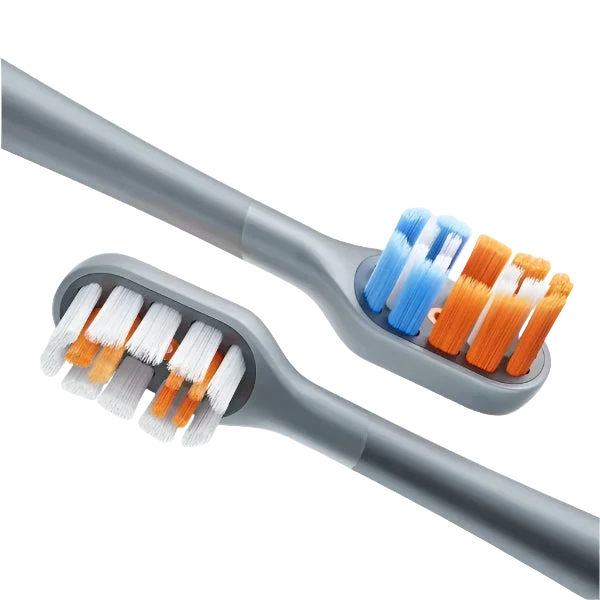
When people choose an electric toothbrush, they often focus on the motor, cleaning modes, or battery life. Yet the part that actually touches the teeth and gums is the brush head—more specifically, thousands of individual bristles.
Those bristles must work in a wet environment, flex repeatedly at high speed, disrupt plaque effectively, and remain gentle around the gumline. That is why every brush head in our product range uses oral-care bristles supplied by DuPont.
But what exactly are “DuPont bristles,” and how can they support effective cleaning while remaining suitable for sensitive teeth and gums?
What Are DuPont Bristles?
“DuPont bristles” is a common consumer term for engineered synthetic filaments developed and supplied for brush applications. It does not describe a single material, stiffness, or bristle shape.
DuPont’s technical literature lists toothbrush filaments such as Tynex® 612 nylon and Herox® 610 nylon. Tynex® 612, for example, is made from polyamide 6.12, commonly known as nylon 612. Unlike natural bristles, engineered monofilaments can be manufactured with closely controlled diameters, lengths, cross-sectional shapes, and mechanical properties.

This gives brush-head designers greater control over important characteristics such as softness, flexibility, resilience, tuft density, and cleaning feel. DuPont, Filament Performance in Brushes
It is important to make one distinction: “DuPont-supplied” identifies the source and quality of the filament material. The finished brush head’s performance also depends on the specific filament grade, diameter, length, tip treatment, tuft density, and bristle arrangement.
Why We Use DuPont Bristles: Consistent Cleaning Performance
Brushing works by bringing the bristles into contact with the tooth surface, gumline, and other difficult-to-reach areas, where they mechanically disrupt and remove dental plaque.
If bristles absorb too much water, lose their designed stiffness, or remain flattened after repeated use, their cleaning action can become less consistent.
According to DuPont’s technical data, Tynex® 612 nylon absorbs approximately 3% moisture under saturated conditions and retains a wet-to-dry modulus ratio of around 0.72. It also achieved a bend-recovery value of 92% under DuPont’s standard laboratory test conditions.
These figures describe material properties—not percentages of plaque removed. However, they help explain why this type of filament is well suited to a toothbrush: it can retain relatively stable mechanical behavior in a wet environment and recover after repeated bending.
In our brush heads, DuPont-supplied bristles provide a reliable material foundation for the intended cleaning pattern. Their resilience helps the bristles repeatedly return toward their original position instead of quickly collapsing or remaining flattened.
The filament itself is only one part of the equation. Bristle layout also matters. The American Dental Association notes that multilevel or angled bristles generally remove plaque more effectively than conventional flat-trimmed designs. American Dental Association: Toothbrushes
A systematic review and meta-analysis also found that, on interdental surfaces, soft tapered-tip bristles may produce greater reductions in plaque and gingival inflammation than soft end-rounded bristles. This evidence supports the importance of bristle geometry, although it should not be interpreted as proof that every DuPont filament automatically produces the same result. PubMed: Systematic review of bristle stiffness and end shape
Gentler on Gums—Without Giving Up Effective Cleaning
A toothbrush must clean along the gumline, so some contact with the gums is unavoidable. The goal is to create enough contact to remove plaque while avoiding excessive pressure on delicate oral tissue.
Bristle diameter, length, and stiffness all affect how a brush head feels. DuPont’s engineering data shows that, when other variables remain unchanged, the stiffness of a round-filament tuft is proportional to the square of the filament diameter and inversely proportional to the cube of its length.
In practical terms, even bristles made from the same material can feel very different when their diameter, length, and tuft configuration are changed. Fine, appropriately selected filaments can flex more readily and distribute pressure across a larger number of contact points.
Bristle-tip finishing matters as well. A review of bristle end-rounding research concluded that properly rounded tips are desirable because they are less likely than sharp or poorly finished tips to abrade oral soft tissue, tooth surfaces, and restorative materials. PubMed: Review of toothbrush bristle end-rounding studies
The American Dental Association recommends a soft-bristled toothbrush used with gentle pressure. This combination helps reduce the risk of gingival injury while still supporting effective daily plaque removal.
A systematic review also found an association between hard bristles and a greater risk of gingival lesions. At the same time, it emphasized that brushing pressure, technique, toothpaste abrasivity, and bristle-tip shape also influence the risk of irritation. Systematic review of bristle stiffness, end shape, and oral soft-tissue effects
This is why our brush-head design does not simply aim to make the bristles feel firm or “powerful.” By beginning with consistent, controllable DuPont filaments, the brush head can be designed to balance cleaning contact with a gentler experience around the gumline.
Can People With Sensitive Teeth Use Our Brush Heads?
For many people with dentin sensitivity or gums that are easily irritated, a soft or extra-soft brush used with gentle pressure is generally the more appropriate choice.
The American Association of Endodontists advises people experiencing temperature sensitivity or exposed root surfaces to try a soft or extra-soft toothbrush. It also recommends avoiding aggressive side-to-side scrubbing, which can contribute to wear on exposed root surfaces. American Association of Endodontists: Tooth Pain
When DuPont filaments are selected in an appropriate soft grade and combined with suitable tip finishing and tuft geometry, they can support effective everyday cleaning with less mechanical stimulation. This makes our appropriately specified soft-bristle brush heads a practical option for many users with sensitive teeth or gums.

However, a soft brush head does not treat the underlying cause of tooth sensitivity. Sensitivity can result from tooth decay, a cracked tooth, gum recession, exposed dentin, enamel wear, or other dental conditions. Pain that is persistent, severe, or limited to one tooth should be assessed by a dental professional.
How Can a Brush Head Be Both Effective and Gentle?
The answer lies in the interaction of three design layers:
- Material performance: Low moisture absorption and good bend recovery help the bristles behave consistently in a wet environment.
- Brush-head geometry: Filament diameter, length, density, angle, and height determine where and how the bristles make contact.
- Contact management: Soft specifications and appropriate tip finishing help distribute pressure and reduce unnecessary mechanical stimulation.
This balance is the reason we use DuPont-supplied oral-care filaments throughout our brush-head range. The DuPont name alone is not a shortcut to better brushing; rather, these engineered filaments give us a stable, controllable material platform from which to design brush heads that clean effectively while remaining comfortable around the teeth and gums.
Good Bristles Still Require Good Brushing
Even a carefully designed brush head should be used correctly. The American Dental Association recommends:
- Brushing twice a day for approximately two minutes, an electric toothbrush like AirJet X5 can help you clean your oral better
- Using fluoride toothpaste
- Positioning the bristles at roughly a 45-degree angle to the gumline
- Applying gentle pressure rather than pressing or scrubbing forcefully
- Replacing the brush head every three to four months, or sooner if the bristles become visibly frayed or matted
Choosing the right bristles matters—but using them gently and consistently matters just as much.


Leave a comment
This site is protected by hCaptcha and the hCaptcha Privacy Policy and Terms of Service apply.